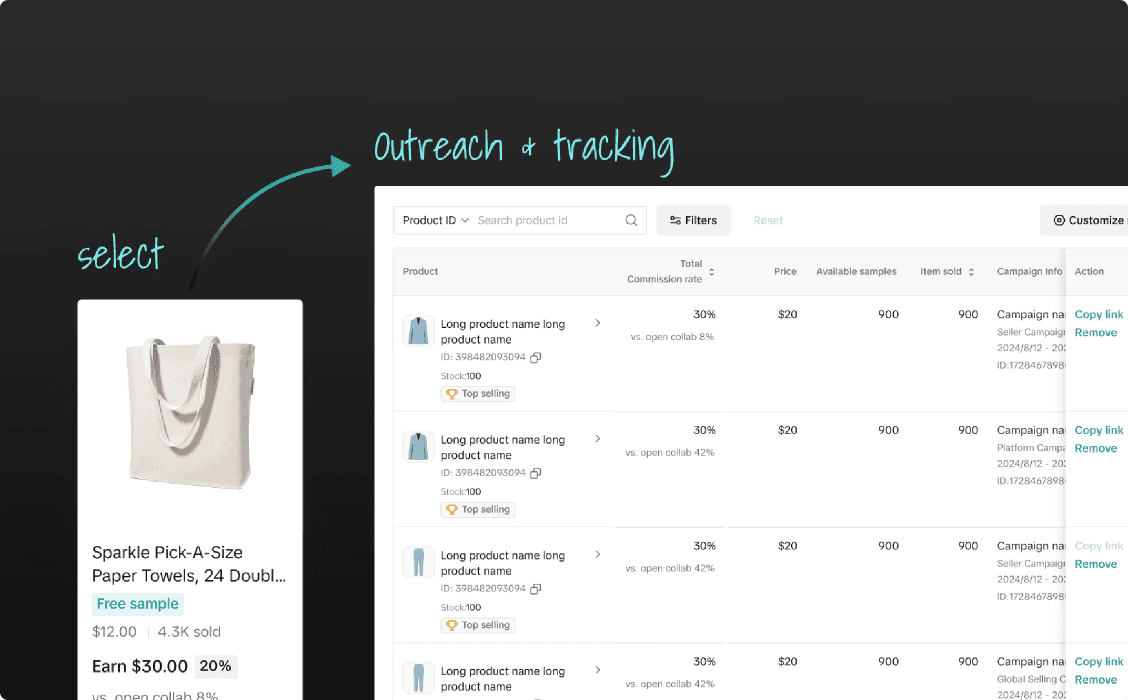
Helping affiliate agencies find the right products and get them to creators, faster.
Team
Yilin Wang (designer)
1 product manager, 2 engineers
Timeline
4 weeks, 2024
Shipped August 2024
Scope
User research, feature ideation, information architecture, and interaction and UI design for both product pools
Key design metrics
What the design moved
Task efficiency
40%
Improvement in task completion efficiency for agencies.
Steps per task
−50%
Fewer steps per task for agencies, on average.
Adoption
90%
Of agency daily active users use the pools instead of the old Campaign marketplace.
Creators reached
+18.9%
More creators reached out to each week.
Problem
Agency products were split across thousands of campaigns, so affiliate agencies couldn't compare, negotiate, or hand them off easily.
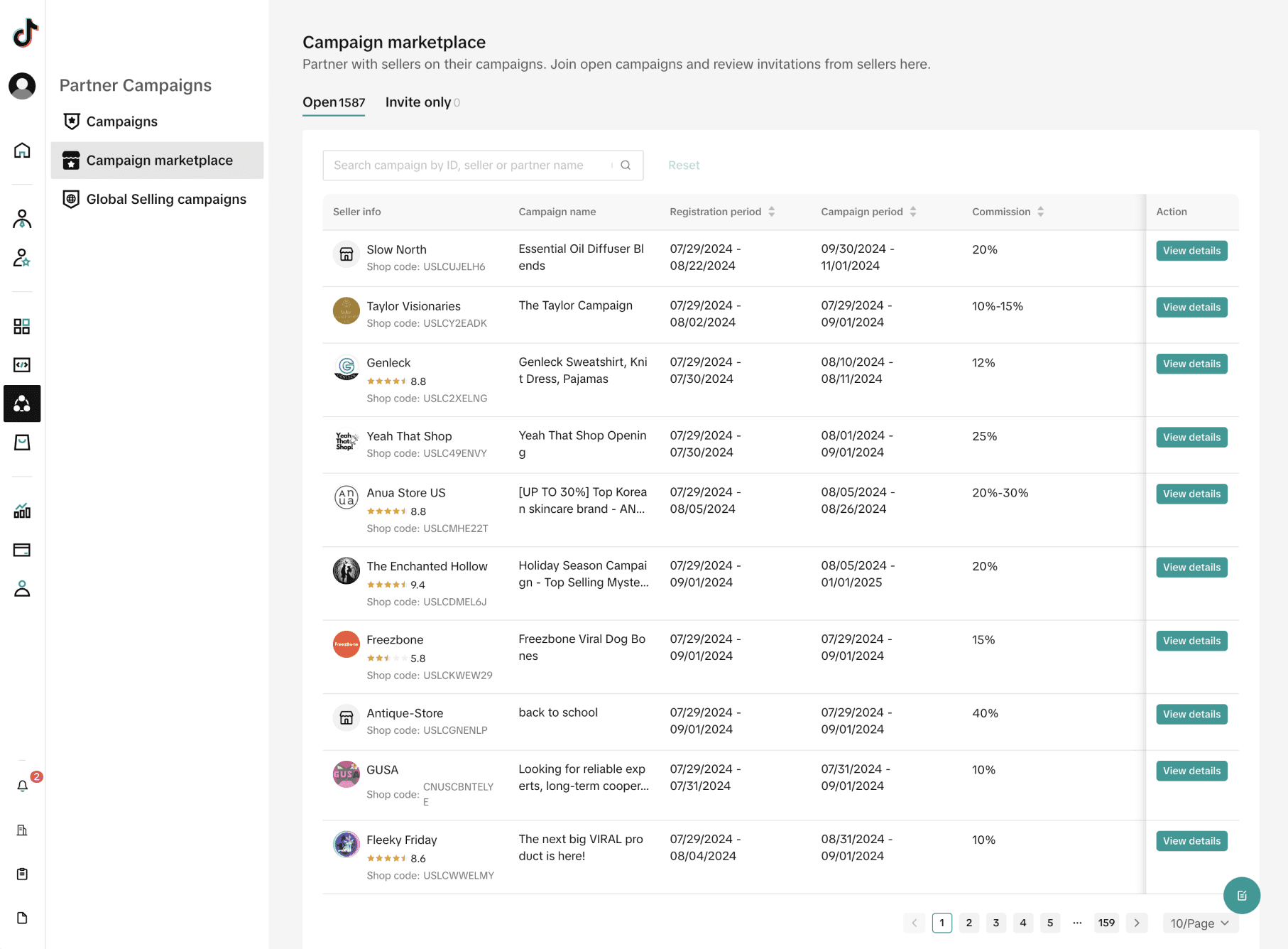
The current design: the Campaign marketplace
Before this project, agencies had to find products across thousands of campaigns. Product details lived inside each campaign, so to compare products, negotiate commission with a seller, or send a product to a creator, they had to open and join campaigns one by one and keep every detail in their heads.
Context
An affiliate agency connects high-quality products with potential creators.
TikTok Shop Affiliate Partners (TAP) are agencies that connect sellers with creators and earn commission on every sale. By helping both creators and sellers grow, they ultimately drive GMV for TikTok Shop.
The ecosystem
Seller
Submits products to campaigns, agrees commission
Affiliate agency
Seller side
Selects products, negotiates commission
Creator side
Sets creator + agency commission, matches creators
Creator
Makes the shoppable video or LIVE
Research
Together with the product manager, I talked to 22 people across 4 agencies and shadowed their daily workflow.
Sources:
- 22 agency interviews: 11 seller-side and 11 creator-side employees
- Data: the funnel from search to pitch, and drop-off at each step
Two roles inside one agency, one facing sellers and one facing creators

Seller-side employee
Jessie
Selects products from every campaign sellers submit, negotiates commission with each seller, then hands the adjusted products to the creator side.
Goals
- Find ideal products to send to creators
- Win the agency a higher commission
Pain points
- Product info is split across thousands of campaigns and hard to compare
- Negotiation is long, with unnecessary steps, and multiplies with every extra product
- After a resubmit, they have to find the campaign and the product all over again
- When someone leaves, their in-progress work is hard to hand over
Decision-making logic · ranked by importance
- 1
Higher commission rate
What they care about most
- 2
Sales performance
Is the product already selling?
- 3
Free samples in stock
Can creators get a sample to try?
- 4
Seller's credit
Product quality and shopping experience

Creator-side employee
Ryan
Sets commission rates for creators and the agency, and sends the products the seller side selected to the creators best suited to them.
Goals
- Match products with creators who make high-quality shoppable videos or LIVEs
- Win the agency a higher commission
Pain points
- Hard to find the products the seller side selected
- Can't send creators one list of products from different campaigns
- Hard to manage shared products and track how they perform
- When someone leaves, their work is hard to hand over
Decision-making logic · ranked by importance
- 1
Commission rate for the creator
What they care about most
- 2
Product price, sample availability, total sales, product rating, seller info, and product status
How these rank varies by agency: it depends on the industry they work in and what their creators are looking for.
Reframing the problem
How might we bring products out of thousands of campaigns into one place, where the seller side can compare and negotiate, and the creator side can pick them up, share, and track them?
High-level solution: rebuild it as two product pools
One pool that gathers products from every campaign so they can be compared and selected, and one for managing what's been selected. The hand-off between them replaces copied links and memory.
Sellers
Submit products to campaigns on the platform
Two pools
Opportunity Pool
Every campaign in one place: compare, select
Pick-Up Pool
Selected products: manage, share, track
Creators
Make shoppable e-commerce videos and LIVEs
Seller side, in the Opportunity Pool
Search and filter products from every campaign
~3 min
Compare on product cards, with seller and campaign info
~3–5 min
Select the product
It moves to the Pick-Up Pool automatically
Creator side, in the Pick-Up Pool
Find selected products in one pool
~1 min
Compare products
~3–5 min
Create a product list
~2 min
Share the list with creators
~2 min
How success was measured
Time to select and send products
How quickly the seller side finds and selects ideal products, and how quickly the creator side finds selected products in bulk and sends them to creators.
Products shared with creators
How many selected products eventually reach creators.
Commission rate growth
Whether the overall commission rate grew after the pools launched.
Agency feedback
What agencies said about the new workflow after launch.
The two pools
One pool to find products, one to put them to work
Each pool serves one side of the agency, with its own goal.
Pool 1 · for the seller side
Opportunity Pool
Goal
Help seller-side employees find ideal products and negotiate commission with sellers in the shortest time possible.
Pool 2 · for the creator side
Pick-Up Pool
Goal
Make getting selected products to the right creators faster and more effective.
Structure
How the two pools are structured, and which products show up first
Opportunity Pool: a grid for browsing
Agencies here are mostly browsing and exploring products, so a grid of cards makes it easier to scan and compare them.
Display logic
Products from ongoing campaigns, with higher commission, and with free samples rise to the top. Unavailable and out-of-stock products sink to the bottom of the pool.
Highlight 01 · Opportunity Pool
How to make it easier for agencies to find ideal products
The filters agencies use most sit on the first level, so most searches take a single click. Anything more specific lives behind Advanced filters, for when a search needs to be precise.
90.4%
of daily active users used these 6 filters to find ideal products
“The filters literally saved my life! It's so much easier to find the products now.”Affiliate agency user
Highlight 02 · Opportunity Pool
How to make it easier and quicker for agencies to compare products
Based on the insights from user research, I categorized all the information agencies need according to their decision logic, then chose what earns a place on the card's first level and what waits on the second.
Highlight 03 · Pick-Up Pool
How to help agencies compare products on the metrics they care about and find the right one
Research showed that, after commission, what agencies look for depends on the industry they work in and what their creators want. So instead of fixing which product metrics appear, the Pick-Up Pool lets each agency choose the ones that matter to them.
Highlight 04 · Pick-Up Pool
How to make it easier for agencies to set up commission for multiple products
Before, the creator side set the creator and agency commission for each product one by one. Now they can select several products and set commission for all of them at once.
−20%
Time spent on creator outreach
More on the process
Each of these went through several rounds of exploration. I’m happy to walk through the options I tried, and why I landed here, in a conversation.